Class Q permitted development: the barn conversion sheet
- Floorspace per dwelling, square metres (the class Q per-dwelling cap applies)
- 150
- Computed on this page from the inputs below
- Floorspace left under the class Q cap for the holding, square metres
- 400
- Computed on this page from the inputs below
- Dwellings the floorspace supports at the per-dwelling cap
- 4.0
- Computed on this page from the inputs below
- Dwellings left under the class Q count cap for the holding
- 6
- Computed on this page from the inputs below
Every figure here comes from the figures you enter and the method stated beside it: your house's width and depth, your curtilage, your barn's floorspace and your dwellings. The limits the sheets read against come from the General Permitted Development Order as it stood on the day it was read, cited on each page with the date. This site publishes no constraints map of its own, no rule text as law and no legal opinion: what a particular authority will accept on a particular plot is the authority's answer at prior approval, and the order cited on each guide is the starting point, not the ruling.
Email me this result
We will send you these figures and a link back to them. One email, nothing else unless you tick the box.
The figures above start from a worked example (150). Change any input and the answer updates as you type, the way it will when the agent's particulars turn out to have measured the wrong wall.
Download the Class Q permitted development: the barn conversion sheet worked example (CSV)
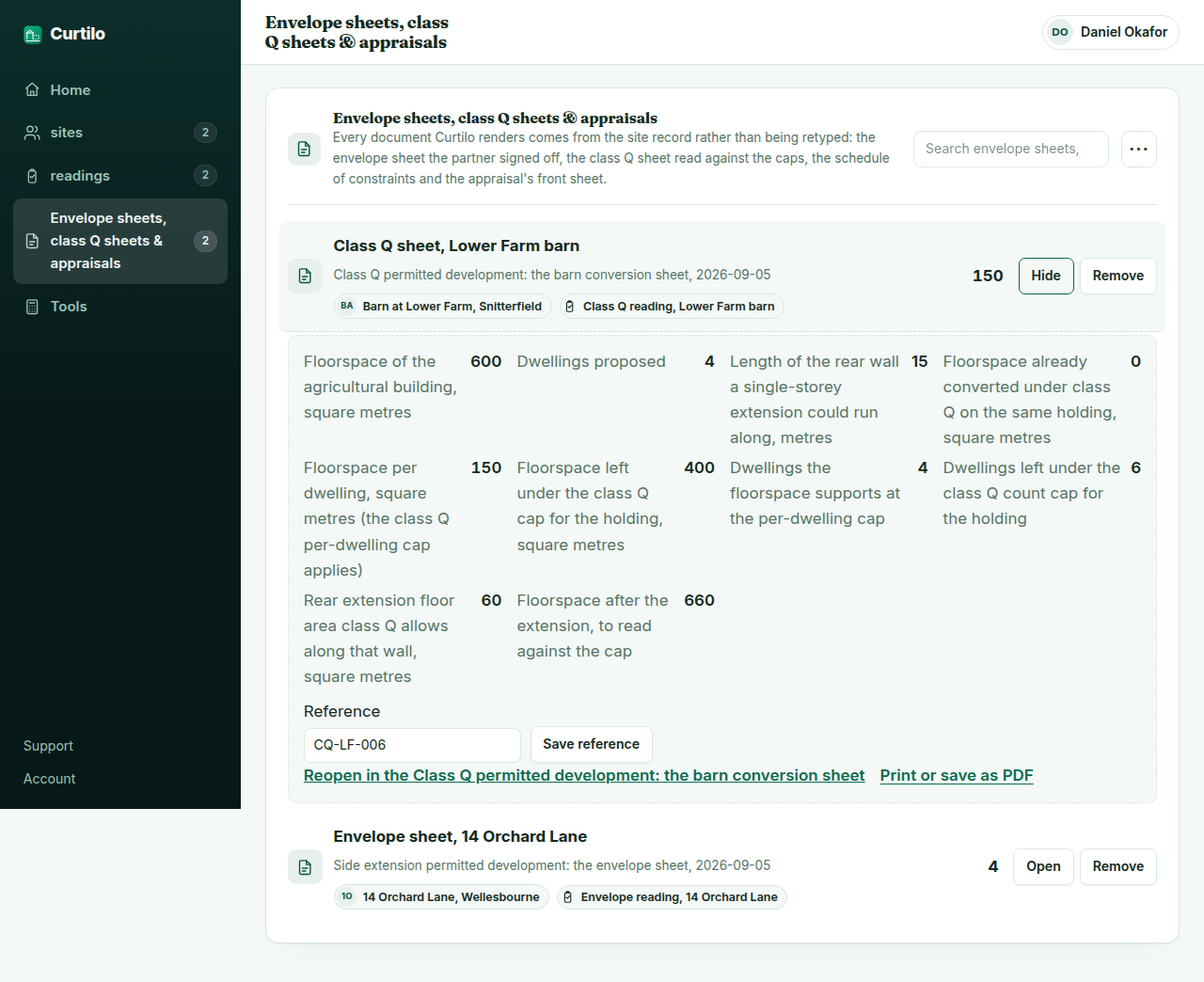
The class Q permitted development barn conversion sheet reads whether an agricultural building converts to dwellings under class Q from your own figures rather than from the agent's confidence: the floorspace of the existing building, the dwellings proposed, the length of rear wall a single-storey extension could run along, and the floorspace the same holding has already converted under the class. It returns the floorspace per dwelling to read against the per-dwelling cap, the headroom left under the holding's floorspace cap, the dwellings the floorspace supports at the cap, the dwellings left under the count cap, the extension floor area the class allows along that wall, and the floorspace after the extension to read against the cap again. It is the reading a developer makes before offering on a barn, with the arithmetic written down so prior approval is applied for on a figure that fits.
Class Q is a set of caps, and the caps are per holding
The class allows an agricultural building to become dwellinghouses subject to prior approval, within a cap on the number of dwellings and a cap on the total floorspace, and both caps count everything the agricultural unit has already converted under the class. A barn read on its own can fit and still fail because the holding converted another building three years ago. The sheet takes the holding's earlier conversions as their own input and returns the headroom from the cap less the building less those, which is the figure the offer depends on.
The per-dwelling floorspace is the second cap, and it decides the unit count
Each dwelling made under the class has a floorspace limit, so a large barn does not become as many units as the plan drawer would like: the sheet returns the floorspace per dwelling from the building and the dwellings proposed, and the dwellings the floorspace supports at the cap, which is usually a smaller number than the particulars promise. Reading the count from the floorspace before the architect draws is what the sheet is for; the order cited below sets the figures and the date they changed.
The extension, the qualifying date and what the sheet does not decide
Since the class was widened it allows a single-storey rear extension of limited depth on a hard surface that existed on the qualifying date, and the sheet reads that area from the wall length you enter and adds it to the floorspace to read against the cap again. What it cannot read is whether the building was in agricultural use on the qualifying date, whether it is structurally capable of conversion without works that amount to rebuilding, and whether the authority will accept the siting and design at prior approval: those are the holding's history, the engineer's report and the authority's answer. Curtilo Pro keeps the reading against the building and the holding, so the next barn on the same unit is read from the file.
What a developer asks before running the Class Q permitted development: the barn conversion sheet
Which figures do I need before using the class Q permitted development barn conversion sheet?
The floorspace of the existing agricultural building measured externally, the dwellings proposed, the length of rear wall an extension could run along on an existing hard surface, and the floorspace the same holding has already converted under class Q, from the holding's own records or the authority's register.
What does the sheet not decide?
Whether the building was in agricultural use on the qualifying date, whether it can be converted without works amounting to rebuilding, whether the site is on designated land where the class does not apply, and whether the authority will grant prior approval. Those are the holding's history, the structural engineer and the authority; the sheet reads the caps.
Is class R the same reading?
No. Class R converts an agricultural building to flexible commercial uses rather than dwellings, with its own floorspace cap and no dwelling count. The guide on class R permitted development on this site sets it out; this sheet reads class Q.
Where the method in this sheet comes from
legislation.gov.uk, The Town and Country Planning (General Permitted Development) (England) Order 2015, Schedule 2 Part 3 Class Q: agricultural buildings to dwellinghouses, the caps on dwellings and floorspace, the extension and the qualifying date. Why the sheet reads the headroom per holding and the floorspace per dwelling: Class Q caps the dwellings and the cumulative floorspace per agricultural unit and limits each dwelling's floorspace, and since the 2024 amendment allows a limited rear extension on an existing hard surface.
GOV.UK planning practice guidance, When is permission required: permitted development rights, prior approval and the conditions the classes attach. Why prior approval sits outside the sheet: the guidance explains that a class subject to prior approval still needs the authority's decision on the matters the class names, so the reading tells the developer what to apply for, not what will be granted.